Helmholtz Munich
Consolidation 2025: 6 launches in 7 months, >60% savings and a performance boost by a factor of 15
In 2025, Helmholtz Munich faced a monumental task: migrating a historically grown, fragmented web landscape to a central TYPO3 v13 system while maintaining full operations.
The result after a year of intensive work: 64% savings in maintenance costs, a Google Speed Index of under 2 seconds, and a scalable platform for the future.

Phase 1 (January – April): The technical foundation
Before migrating the first site, we focused on an uncompromising architecture. The goal was not just a relaunch, but the building of a "content engine" for the coming years.
- High-End Stack: Using TYPO3 13 LTS with 88,417 lines of clean PHP code.
- Professional DevOps: A 4-stage CI/CD pipeline (Development → Preview → Release → Production) via GitLab secures each of the 3,045 commits.
- Quality assurance: Building a complete test page tree that represents all conceivable content variations (e.g., news with top news, text-image combinations). This guarantees that updates will not break any layouts in the future.
Phase 2 (May – December): The industrial migration
Instead of manually rebuilding each page, we opted for automation. Our team wrote 41,000 lines of specialized migration code to export and transform content from the legacy systems (v11/v12) and import it into the new structures (b13/container instead of Gridelements).
The timeline of achievements:
- May 27th: lungeninformationsdienst.de (pilot project)
- Performance: Speed Index improved from 5.7s to 1.4s (-75%).
- Quality: Google PageSpeed Score: 99-96-100-100.
- 30. Juli: dzd-ev.de
- The record holder: Speed Index reduced from 38.9s to 2.4s (-94%).
- 10. September: helmholtz-munich.de (Main website)
- 29. September: allergieinformationsdienst.de
- Nov-Jan: diabinfo.de (Silent Launch) & clever-gesund-info.de
Outlook: Scaling, Support & Evolution
The end of 2025 doesn't mark the end, but rather the starting point for a long-term partnership. The infrastructure is established, and any initial teething problems have been resolved. In 2026, not only will up to 30 additional websites migrate to the central platform more efficiently than ever before, but we will also remain operationally involved. Through proactive monitoring and continuous support, we ensure that performance and security remain at their current top level.
At the same time, the platform is not static: We are constantly developing the system and integrating new features to dynamically adapt the website to the future needs of Helmholtz Munich.
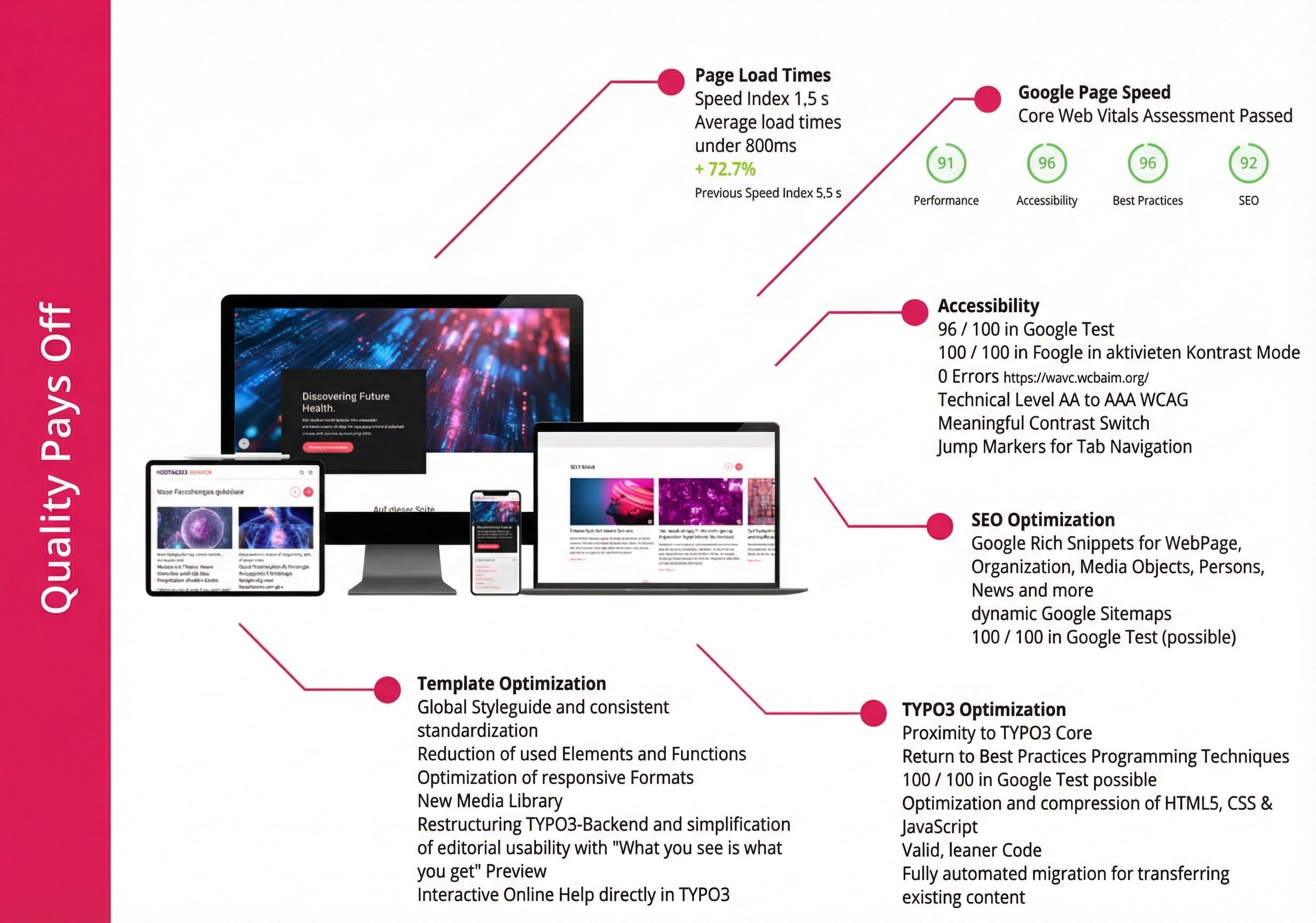
Q&A: The results in detail

Question: Is the effort really financially worthwhile?
Answer: The numbers are clear.
- Maintenance costs for legacy systems (2024): Mid-six-figure amount
- Maintenance costs for the new system (2025): almost one-third of the previous year's amount. This corresponds to annual savings of 64% – even though the new system was built and migrated in 2025, AND the old infrastructure was maintained in parallel. The old systems will be completely phased out from 2026 onwards.

Question: Do users notice the difference?
Answer: Yes, massively. Average loading times system-wide are below 400ms. All websites achieve a "Pass" rating in the Core Web Vitals (Google's most important performance indicator). Editors also benefit: Thanks to true WYSIWYG previews in the backend and integrated online help, first-level support requests have decreased noticeably.

Question: Many relaunches fail due to a lack of clean data migration. How did you technically solve the migration of thousands of pages?
Answer: We "industrialized" the process. Instead of relying on manual copy-paste, we developed a custom migration logic (approximately 41,000 lines of PHP code). This software not only exports the legacy data but also "refactors" it fully automatically during the import process: Outdated layout tables were transformed on-the-fly into modern, accessible container elements. The migration thus simultaneously served as an automated quality improvement for the entire content.
![[Translate to English:] Google Analytics Darkmode](/fileadmin/_processed_/4/a/csm_analytics2_3fad7b3426.webp "[Translate to English:] Google Analytics Darkmode")
Question: What about accessibility and SEO/GEO?
Answer: As a public research institution, this is essential for Helmholtz.
- Accessibility: WCAG compliance (levels AA to AAA), 0 errors in the wave test and features such as contrast switches and skip marker navigation.
- SEO/GEO: 100/100 points in the Google test, dynamic sitemaps and extensive Schema.org integration (rich snippets for news, people, media) for Google and AI crawlers.
helmholtz-munich.de now is

Gallery & Features